






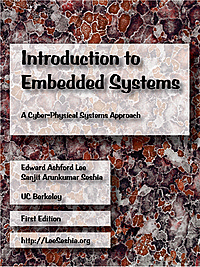
Introduction to Embedded Systems - A Cyber-Physical Systems Approach
This book strives to identify and introduce the durable intellectual ideas of embedded systems as a technology and as a subject of study. The emphasis is on modeling, design, and analysis of cyber-physical systems, which integrate computing, networking, and physical processes. This book is intended for students at the advanced undergraduate level or the introductory graduate level, and for practicing engineers and computer scientists who wish to understand the engineering principles of embedded systems.

Summary
This book presents foundational concepts for modeling, designing, and analyzing embedded and cyber-physical systems, emphasizing interactions between computation, networking, and physical processes. Readers learn rigorous modeling techniques, real-time considerations, and methods for verifying correctness in embedded designs.
Key Takeaways
- Understand core modeling formalisms for cyber-physical systems, including synchronous and hybrid models.
- Apply design principles that integrate sensing, computation, communication, and control for robust embedded systems.
- Analyze timing, concurrency, and correctness concerns relevant to real-time and networked embedded applications.
- Use formal and model-based methods to specify and verify behavior of safety-critical embedded systems.
Who Should Read This
Advanced undergraduate or early graduate students, and practicing engineers who want rigorous foundations in modeling, design, and analysis of cyber-physical and embedded systems.
Still RelevantIntermediate
Related Documents
- Consistent Overhead Byte Stuffing TimelessIntermediate
- PID Without a PhD TimelessIntermediate
- Can an RTOS be really real-time? TimelessAdvanced
- Memory Mapped I/O in C TimelessIntermediate
- Design and Implementation of the lwIP Stack Still RelevantAdvanced